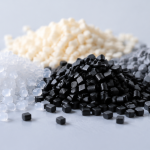
 PLA-CF pellets combine carbon fiber reinforcement with the advantages of pellet-based extrusion. Known for their rigidity, lightweight structure, and dimensional stability, PLA-CF materials serve functional prototypes, industrial tooling, and customized components.
Conventional PLA-CF filament works well for smaller functional parts and desktop 3D printing. However, large-scale manufacturing requires higher material throughput, efficient raw material handling, and reliable production performance. PLA-CF pellets provide an alternative feedstock for manufacturers operating industrial extrusion systems.
Where Conventional PLA-CF Filament Reaches Its Limits
PLA-CF combines polylactic acid (PLA) with carbon fiber reinforcement. Carbon fiber increases stiffness and helps maintain dimensional stability, while creating the characteristic matte surface associated with this material.
However, PLA-CF also has performance limitations that manufacturers must consider.
| Material Characteristic | Main Limitation | Application Impact |
|---|---|---|
| High Rigidity | Limited elongation | Brittle failure under excessive impact |
| Heat Resistance | Relatively low thermal resistance | Restrictions in high-temperature environments |
| Impact Resistance | Limited toughness in some grades | Reduced suitability for impact-sensitive parts |
| Material Processing | Filament requires additional extrusion and winding | Extra processing steps before printing |
How PLA-CF Pellets Improve 3D Printing Efficiency
PLA-CF pellets bring several practical advantages to industrial 3D printing, particularly when manufacturers move toward larger components and higher material consumption.
Higher Material Throughput
Pellet-fed extrusion processes raw material directly through an industrial extrusion system.
- Supports large-format 3D printing.
- Handles substantial material consumption.
- Enables higher deposition rates with suitable equipment.
This makes PLA-CF pellets particularly useful for oversized prototypes, industrial fixtures, and customized structures.
More Direct Material Processing
Unlike filament-based printing, pellet extrusion does not require the separate filament production and winding stages before printing.
- Direct feeding into compatible extrusion systems.
- Fewer intermediate material-processing steps.
- Efficient handling of bulk raw materials.
Production Cost Optimization
For high-volume manufacturing, PLA-CF pellets create opportunities to reduce feedstock costs through bulk purchasing and simplified material processing.
The actual cost advantage depends on equipment investment, production volume, energy consumption, and material waste.
Greater Production Flexibility
Industrial pellet extrusion supports different component sizes and production requirements. Manufacturers can select suitable extrusion equipment, processing parameters, and material grades according to the intended application.
Where Can PLA-CF Pellets Be Used?
The combination of carbon fiber reinforcement, lightweight construction, and pellet extrusion creates opportunities across several industrial sectors.
| Industry | Typical Applications | Main Benefits |
|---|---|---|
| Automotive | Prototype parts, testing fixtures | Large-format production |
| Robotics | Mounting brackets, gripper structures | Lightweight rigidity |
| Industrial Manufacturing | Assembly fixtures, positioning tools | Customized tooling |
| Architecture | Large models, display structures | High-volume extrusion |
Industrial Tooling
Assembly fixtures, positioning tools, and customized supports require stable geometry and sufficient rigidity. PLA-CF provides a lightweight material option for tools operating under suitable mechanical loads and temperatures.
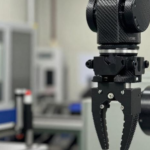
Robotics and Automation
Robot mounting brackets, gripper housings, and equipment supports benefit from lightweight construction and increased stiffness. These components help reduce structural weight while maintaining the rigidity required for their intended functions.
Automotive Prototyping
Automotive development involves large prototype components, customized testing fixtures, and functional models. Pellet extrusion supports these projects through higher material deposition rates and direct bulk material processing.
Architectural Modeling
Large architectural models and display structures require considerable material volumes. PLA-CF pellets provide a practical feedstock option for compatible large-format extrusion systems.
What to Consider When Choosing PLA-CF Pellets
Selecting PLA-CF pellets requires evaluating material properties alongside extrusion equipment compatibility.
| Evaluation Factor | Why It Matters |
|---|---|
| Carbon Fiber Content | Influences stiffness and material density |
| Melt Flow | Determines extrusion consistency |
| Impact Strength | Indicates resistance to sudden mechanical stress |
| Layer Adhesion | Affects printed component integrity |
| Moisture Content | Influences processing stability |
| Dimensional Stability | Helps maintain component accuracy |
Proper material drying, processing temperature, screw configuration, and nozzle selection also contribute to consistent printing quality.
Manufacturers should evaluate these factors through extrusion trials and mechanical testing before moving into production.
PLA-CF Pellets Bring Industrial 3D Printing Closer to Production
PLA-CF pellets extend the use of carbon fiber reinforced PLA into large-format and production-oriented 3D printing. Their advantages include direct material processing, higher deposition potential, and reduced dependence on intermediate filament production.
From automotive prototypes to robotic components and industrial tooling, PLA-CF pellets provide manufacturers with another way to handle larger projects and demanding material requirements.