3D Printing Pellets play an important role in pellet-fed 3D printing. Their size, shape, and consistency affect how smoothly materials move through the feeding system and how steadily they are delivered to the extruder. Choosing pellets with suitable physical characteristics helps maintain stable material flow, supports consistent extrusion, and improves overall printing performance.
For manufacturers developing pellet-fed 3D printing workflows, understanding these characteristics helps improve material handling, reduce feeding interruptions, and maintain consistent production quality.
Why Pellet Size Matters in 3D Printing
Pellet size directly influences how material moves through a hopper, feeding mechanism, and extrusion system. Consistent pellet dimensions support more predictable material flow, allowing feeding equipment to operate under controlled conditions.
When pellet sizes vary significantly, smaller particles may move differently from larger ones. This can create uneven material distribution inside the hopper or affect the consistency of material delivery.
Size variation also influences how pellets occupy available space. A mixture of significantly different dimensions can produce inconsistent packing behavior, affecting how material reaches the feeding mechanism.
For pellet-fed 3D printers, maintaining suitable and consistent pellet dimensions helps establish a more reliable feeding process, particularly during extended printing operations.
How Pellet Shape Influences Material Flow
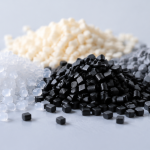
Pellet shape is another important consideration in material handling. Common polymer pellet forms include cylindrical, spherical, and irregularly shaped granules.
Each geometry interacts differently with feeding equipment.
Cylindrical Pellets
Cylindrical pellets are widely used in plastic processing because they can be manufactured with relatively consistent dimensions. Their uniform geometry supports predictable material handling when pellet length and diameter remain controlled.
Spherical Pellets
Spherical pellets offer a compact geometry and can move freely through certain feeding systems. However, their rolling behavior and packing characteristics require consideration when designing hopper and feeding configurations.
Irregular Pellets
Irregularly shaped particles may create inconsistent packing and friction conditions. Depending on their dimensions and surface characteristics, they can increase the risk of bridging or uneven feeding in equipment that is not designed for their geometry.
The best pellet shape depends on the feeding system, material characteristics, and equipment design rather than one universal standard.
The Connection Between Pellet Geometry and Feeding Stability
 Pellet geometry becomes particularly important when materials enter automated feeding systems.
A hopper must maintain a continuous supply of material toward the feeding mechanism. When pellets have inconsistent dimensions or excessive irregularities, their movement can become less predictable.
One common issue is bridging, where pellets form an arch-like structure inside the hopper and interrupt material discharge. Another is inconsistent feeding caused by variations in pellet distribution.
These conditions can affect extrusion continuity and create fluctuations in deposited material.
For large-format 3D printing, where components require extended extrusion periods, stable feeding becomes especially important. Consistent pellet geometry helps equipment maintain a more predictable material supply throughout the printing process.
What Manufacturers Should Check When Selecting 3D Printing Pellets
Pellet quality evaluation should include more than polymer composition and mechanical properties. Physical specifications also deserve attention.
Important factors include:
- Size distribution: Check whether pellet dimensions remain consistent within the specified production range.
- Shape uniformity: Evaluate whether pellets maintain a relatively consistent geometry.
- Surface condition: Look for excessive dust, broken particles, and damaged pellet edges.
- Foreign particles: Ensure that contamination does not interfere with material feeding or processing.
- Equipment compatibility: Confirm that pellet dimensions match the requirements of the intended feeding system.
These checks help manufacturers identify material handling risks before beginning production.
Better Pellet Design for More Reliable Printing
The physical design of 3D Printing Pellets directly contributes to material handling performance. Consistent dimensions, suitable geometry, and controlled particle quality help feeding systems deliver material more predictably.
For pellet manufacturers, controlling pellet specifications is an important part of product quality. For equipment operators, selecting pellets that match the feeding system helps reduce interruptions and maintain extrusion stability.