3D printing pellets give manufacturers more options for producing functional components with different mechanical requirements. Among the available thermoplastics, PETG and TPU serve two distinct purposes. PETG supports rigid structures, while TPU provides flexibility and elastic recovery. Comparing these materials requires an understanding of the actual products they create, the working conditions they face, and the functions they perform in industrial applications.
PETG 3D Printing Pellets: Creating Rigid Industrial Components
PETG (Polyethylene Terephthalate Glycol-modified) is a practical choice for components that require rigidity, impact resistance, and dimensional stability. Its material characteristics support the production of functional parts through pellet extrusion, particularly when manufacturers need customized geometries or larger components.
One example is an industrial electronic enclosure. This housing protects internal electronics, organizes cables, and provides mounting positions for switches, sensors, and connectors. PETG provides the structural rigidity needed to maintain the enclosure’s shape during normal use.
PETG also serves as a suitable material for several other products:
| Equipment mounting brackets | Machine protective covers | Production fixtures | Custom tool organizers |
 |
 |
 |
 |
| Supporting sensors, control panels, and auxiliary devices | Enclosing electrical assemblies and exposed components | Positioning workpieces during assembly and inspection | Creating storage structures for industrial workstations |
These applications rely on defined geometries and structural support. During production, wall thickness, print orientation, layer bonding, and moisture control require careful attention. These factors directly affect the quality and mechanical properties of the finished product.
TPU 3D Printing Pellets: Manufacturing Flexible Functional Parts
TPU (Thermoplastic Polyurethane) serves a different purpose. Its elasticity, flexibility, and abrasion resistance make it suitable for components that experience repeated bending, compression, friction, or movement.
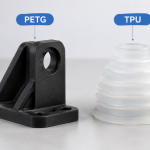
A practical example is a vibration-damping foot for industrial equipment. Installed between a machine and its supporting surface, a properly designed TPU foot provides a flexible contact layer that helps reduce vibration transmission. Its performance depends on Shore hardness, component geometry, applied load, and operating frequency.
Other practical TPU products include:
- Flexible cable glands: Protecting cable entry points while accommodating movement.
- Protective boots: Covering exposed joints, connectors, and mechanical interfaces.
- Flexible air ducts: Connecting components that require movement during operation.
- Anti-slip pads: Providing flexible contact surfaces for equipment and fixtures.
TPU hardness plays an important role in product design. Shore A ratings indicate the material’s resistance to indentation, while wall thickness and geometry determine how the finished component deforms under load.
For TPU pellet extrusion, controlled material feeding, proper drying, and suitable processing temperatures are essential. The feeding system must accommodate the selected TPU grade to maintain consistent material delivery and extrusion quality.
PETG vs TPU 3D Printing Pellets: Key Differences
PETG maintains a relatively rigid structure, while TPU accommodates deformation and movement.
| Comparison | PETG Pellets | TPU Pellets |
|---|---|---|
| Material behavior | Rigid thermoplastic | Flexible elastomeric thermoplastic |
| Main properties | Stiffness and impact resistance | Elasticity and abrasion resistance |
| Flexibility | Maintains defined shapes | Bends and compresses |
| Typical products | Housings, brackets, fixtures | Seals, protective boots, damping feet |
| Design priority | Structural support | Flexible deformation and recovery |
| Processing focus | Moisture control and layer bonding | Moisture control and suitable feeding |
Neither material replaces the other. The correct choice depends on the mechanical requirements of the finished component and its intended operating environment.
How to Choose PETG or TPU 3D Printing Pellets
Material selection starts with the finished product’s working conditions. PETG is suitable when a component requires rigidity, impact resistance, and dimensional stability. TPU is suitable when a design requires elasticity, compression, abrasion resistance, or vibration isolation.
The goal is to match the polymers based on the actual functions of the components, rather than seeking a universally superior material. By selecting PETG and TPU 3D printing particles according to these requirements, functional industrial parts with appropriate material properties can be developed.