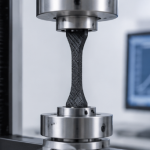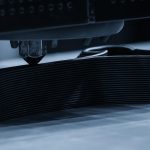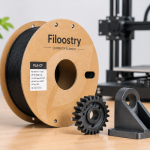
Nylon 6 Carbon Fiber Filament is designed for functional 3D printed parts that require high stiffness, mechanical strength, and dimensional stability. But how well does it maintain these properties over time? For components exposed to repeated loads, temperature changes, and moisture, long-term performance matters as much as initial strength.
PA6-CF combines a nylon 6 polymer matrix with carbon fiber reinforcement. Carbon fibers improve rigidity and help reduce deformation under mechanical stress, making the material suitable for industrial fixtures, structural brackets, and robotic components. However, environmental exposure and continuous loading still influence its performance throughout its service life.
How Does Nylon 6 Carbon Fiber Filament Maintain Strength Over Time?
 The long-term mechanical performance of Nylon 6 Carbon Fiber Filament depends on the interaction between its nylon matrix and carbon fiber reinforcement.
Carbon fibers increase stiffness and help resist deformation under applied loads. Compared with standard PA6, PA6-CF generally offers greater rigidity, making it suitable for components requiring structural support and dimensional consistency.
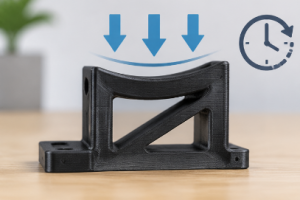
However, reinforcement does not eliminate material aging or environmental effects. Repeated loading can cause gradual deformation, particularly when components operate under sustained stress. This behavior, known as creep, is an important consideration for parts designed for long-term use.
Can Moisture Cause Long-Term Changes in PA6-CF?
PA6 is hygroscopic, meaning it absorbs moisture from the surrounding environment. As moisture enters the polymer matrix, it acts as a plasticizer, changing the material’s stiffness and mechanical behavior.
For PA6-CF components, moisture exposure can affect several properties:
| Performance Factor | Potential Effect of Moisture |
|---|---|
| Mechanical stiffness | Reduces the stiffness of the nylon matrix |
| Dimensional stability | Causes dimensional changes |
| Mechanical consistency | Creates variations in component performance |
Carbon fiber reinforcement improves dimensional stability compared with unreinforced nylon, but it does not eliminate moisture absorption.
Proper filament drying before printing and moisture-controlled storage after opening help maintain consistent material conditions. Finished components should also be evaluated according to their operating humidity.
How Do Temperature and Continuous Loads Affect PA6-CF Durability?
Temperature and mechanical stress directly influence how long a PA6-CF component maintains its functional performance.
At elevated temperatures, nylon becomes more susceptible to deformation. When a component carries a continuous load under these conditions, creep can gradually affect its shape and structural stability.
Printing quality also plays an important role. Insufficient layer bonding creates weak interfaces that can become failure points under repeated mechanical stress.
The following factors deserve particular attention:
- Operating temperature: Higher temperatures can increase deformation under sustained loads.
- Load duration: Continuous stress increases the risk of creep.
- Printing orientation: FDM parts exhibit different mechanical properties depending on loading direction.
- Layer adhesion: Poor bonding reduces structural reliability.
Therefore, manufacturers should evaluate temperature, load duration, and component geometry together rather than relying solely on initial tensile strength.
How Can You Extend the Service Life of Nylon 6 Carbon Fiber Parts?
Maintaining consistent performance requires proper material handling, printing, and component design.
| Key Practice | Recommended Approach |
|---|---|
| Moisture control | Dry filament according to manufacturer recommendations and store it in a sealed, moisture-controlled environment |
| Printing conditions | Optimize nozzle temperature, printing speed, and build plate temperature |
| Structural design | Avoid unnecessary stress concentrations around holes, corners, and mounting points |
| Application testing | Evaluate components under actual temperature, humidity, and mechanical load conditions |
These measures help reduce processing defects and improve the consistency of finished components. Application-specific testing remains essential for parts exposed to demanding operating environments.
Is Nylon 6 Carbon Fiber a Reliable Material for Long-Term Use?
Nylon 6 Carbon Fiber combines high rigidity, mechanical strength, and lightweight construction for functional 3D printed components. Its carbon fiber reinforcement improves stiffness and helps control deformation, while the nylon matrix provides the structural foundation.
However, long-term reliability depends on more than initial mechanical properties. Moisture absorption, temperature exposure, continuous loading, and printing quality all influence component performance.
For manufacturers selecting materials for industrial applications, evaluating the entire service environment provides a more reliable basis for material selection. With proper material handling, optimized printing parameters, and application-specific testing, PA6-CF serves as a practical option for demanding functional components.